


Every hotel company talks about efficiency. Faster check-ins. Fewer steps. Tighter labor models. Technology that removes the need for another human on the payroll.
And on a spreadsheet, it all makes sense.
But here is what Bashar Wali and Mandy Murray kept circling back to during a recent episode of Beyond the Binder:
The industry’s obsession with efficiency is quietly gutting the thing guests actually pay for.
Not the bed. Not the shower. Not the marble lobby. The thing that turns a commodity into an experience: a human who genuinely gives a damn.
Efficiency, as most hotels practice it, has become code for removing people. And when you remove the people, you remove the only thing that separates you from a self-storage unit with better lighting.
The technology showed up ready. The question is whether we’re using it to remove friction or remove humans. Those are two very different things.
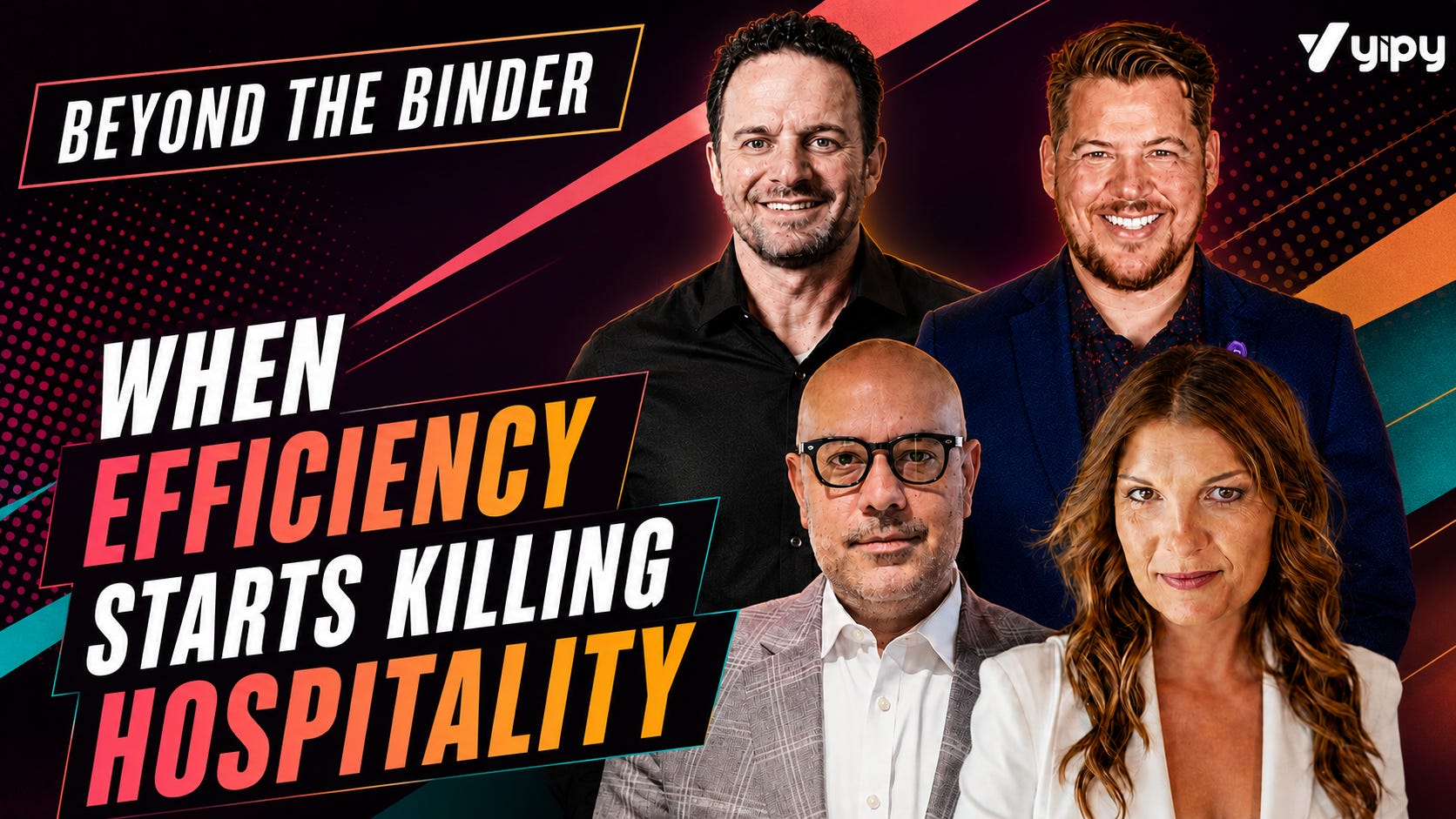
👉 Watch the full conversation here.
What We Learned About Efficiency, Hospitality, and the Human Element
1. Efficiency Does Not Mean Fewer People. It Means Less Friction.
The hotel industry has treated efficiency and headcount reduction as the same thing for years. It is not.
Bashar put it bluntly: use technology to remove friction, not to remove humans.
When a guest checks in, why are you asking for their address? What are you going to do with it? Send a gift? When someone books on your website, why does it take 74 steps and a keyboard switch from alpha to numeric for a zip code field?
That is friction. And it is why guests abandon your direct booking engine and go to Expedia, where three clicks gets the job done.
The winning formula is not fewer employees. It is fewer pointless steps, so the employees you do have can stop processing transactions and start creating interactions.
Bashar used a tire shop in Portland to make the point. Les Schwab. A commodity business. Tires. Their move: when a car pulls up, someone runs from inside the store to greet the driver at the door. Not walks. Runs. They are more expensive than Walmart or Costco. They crush it anyway.
Running to the car does not cost more money. Walking around the counter at Nordstrom does not cost more money. Calling a guest before arrival, the way Mandy’s team does at every independent property she advises, does not cost more money.
It costs intentionality. And that is what most hotels have cut in the name of efficiency.
2. Hotels Are in the Shelter Business. That Is the Problem.
Bashar referenced Maslow’s hierarchy of needs, and the framing stuck.
Shelter sits at the very bottom of the pyramid. Physiological needs. Food, water, oxygen, a roof. Hotels are, at their most basic, in the shelter business. And shelter is a commodity.
A commodity is price-driven by definition. Wheat. Gas. Oil. If a hotel sells a bed and a shower, it competes on price and location. Nothing else. That is a race to the bottom.
The only thing that moves a hotel from the bottom of the pyramid to the top, from shelter to what Maslow called self-actualization, is making a guest feel like they matter.
Bashar told a story about a Days Inn. A couple checks in with their 40-year-old daughter. The front desk associate overhears that it is the daughter’s birthday. Later, a bag of M&M’s from the vending machine shows up at the room with a sticky note that says happy birthday.
One dollar. One gesture. That is transcendence. Not because it was expensive. Because someone saw them.
If the only reason a guest chooses your hotel is points, that is not loyalty. That is bribery. Take away the points and see if they come back. If they do not, you never had them.
3. Scripts Kill the Thing You Are Scripting For.
Mandy came out swinging: abandon scripts. Abandon post-stay surveys. Both need to go.
Bashar agreed on scripts but added a critical nuance. You cannot just tell someone to “go be nice.” That is chaos, not hospitality. Fritz van Paasschen, former CEO of Starwood, had the right framing: flexibility within a framework.
The difference between a script and a framework is the difference between reading lines and knowing your role. A script tells the associate what to say. A framework tells them what the guest should feel, and trusts them to get there.
The Nordstrom associate walks around the counter to hand you your purchase at eye level. Macy’s hands it over the counter. Both probably think they are providing great service. Only one makes you feel like a person instead of a transaction.
That distinction does not come from a script. It comes from competence. When people know what great looks like in their specific environment, when they are trained on the framework and believe in it, they do not need someone else’s words. They find their own. And those words land because they are genuine.
4. Culture Is Not a Poster. It Is a Cult Worth Joining.
The most uncomfortable moment in the conversation was also the most honest.
Bashar said the hotel industry’s version of culture is, by and large, a poster on a breakroom wall written by executives who would not recognize culture if it hit them in the face.
His argument: real culture operates like the best version of a cult. The leader drinks the Kool-Aid first. The members believe because they have seen it practiced, not just preached. People join because they feel seen, valued, and celebrated, not because they were handed a laminated card with the company values.
Apple is a cult. People do not buy Apple products because of specs. They buy because they subscribe to what Apple represents. If Apple made $50 toilet paper tomorrow, people would buy it, because the cult has earned that trust.
Hotels need to think the same way about their employees. Why should someone choose to work for you? Not the paycheck. Not the benefits. The market dictates those. What are you offering beyond compensation that makes a Gen Z worker, who has more options and fewer obligations than any generation before them, want to show up for you specifically?
Gen Z has now surpassed boomers in workforce share. They care about how they are treated, what the company stands for, and whether leadership lives the values it prints on the wall. If the answer to any of those is “not really,” they leave. And they should.
Mandy reinforced it with a simple example. An employee texts asking to leave early because their father just had surgery. The response is not “let me check the schedule.” The response is “What do you need? How can we help?”
That is culture. The poster on the wall is decoration.
5. Surveys Are Solving Yesterday’s Problem.
Mandy’s take on surveys was decisive: if a guest had a problem, they should have told you while they were still in the hotel. And someone on your team should have caught it before the guest had to say anything.
A post-stay survey is an admission that you missed it. And by the time the results come in, the guest is gone. What are you going to do about it now?
Bashar took it further. The only survey question that matters is: would you recommend this place to a friend? Yes or no. If the answer is no, the burden is on you to figure out why. But the real work should happen during the stay, not after.
He referenced a concept from a student he met while guest lecturing at Boston University. The idea: when employees clock in, they tap a simple red, yellow, or green indicator. No context. No explanation. Just a pulse check. If someone hits red three days in a row, it is on the manager to go have a cup of coffee with them and find out what is going on.
Think about what that communicates. Not “how are the guests doing?” but “how are you doing?” Marriott’s original motto had it right: take care of your people, who will take care of your guests, who will take care of you. People first. The industry forgot that part.
What You Can Do Today
You do not need a technology overhaul to start closing the gap between efficiency-on-paper and hospitality-in-practice.
First: Book a reservation at your own hotel. Go through every step. The website. The confirmation email. The check-in process. Order room service. Push the buttons. Use the app. If you have not done this yourself, and made your management team do the same, you are letting your guests be the lab rats. That is Bashar’s word, and he is right.
Second: Pick one friction point and kill it. Not a human. A step. An unnecessary form field. A process that exists because “we’ve always done it that way.” Remove it and measure what happens. The goal is to free your people from transactional busywork so they can do the work that actually matters.
Third: Ask your employees how they are doing before you ask how the guests are doing. Not a survey. A conversation. A manager who notices. A culture that says your people are your most important customer, because they are.
The Bottom Line
Hotels are not a commodity. A bed and a shower is a commodity. What makes a hotel worth choosing, worth returning to, worth recommending, is the human being who runs to the car, who buys the M&M’s, who walks around the counter.
The winners will not be the hotels that automate the most. They will be the ones that use technology to strip away friction so their people can do what no machine can: make a stranger feel like they belong.
Efficiency is not the enemy. But efficiency without intention is how you turn a hotel into a self-storage unit.
And nobody writes a TripAdvisor review about a storage unit.
I am always SHOCKED when I hear an executive say, "Our leaders/owners don't focus on standards."
Why???? Because standards aren't just saying hi and scripting your employees. No way!
Standards are how you receive and store food or how you process a comp vs. an adjustment. If you don't care about standards, you don't care about your business. Period. Full Stop.
We need to reframe how we look at standards. Not everyone is chasing a rating. But everyone is trying to pass a health inspection, an OSHA audit, and make sure they are processing their financials correctly.
Instead of saying, "I don't care about standards." Think about which directions matter and empower your staff and guests.