Every hotel that buys a “standards” tool thinks they’re solving one thing:
“We just need better training.”
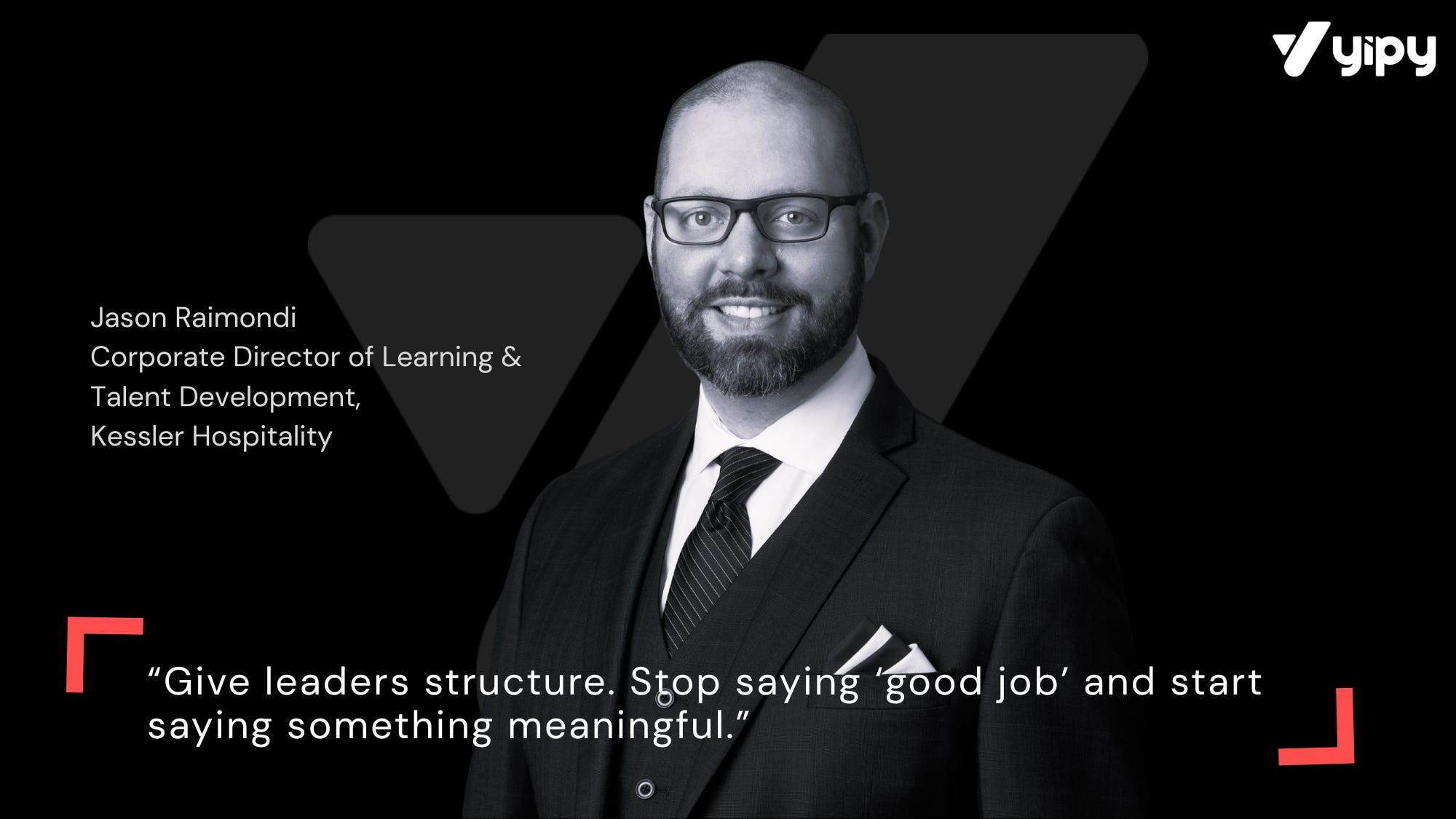
But as Jason Raimondi told Adam in their conversation, training isn’t the problem.
It never was.
The real problem is this:
👉 Leaders cannot hold people accountable to standards they don’t consistently observe, reinforce, and measure.
This is what Yipy calls the true enemy: the absence of a system that turns good standards into consistent behavior— every day, across the entire operation. It’s not that standards are unclear. It’s that execution isn’t reinforced in the flow of work. It’s about behavior, leadership, culture, and the absence of one living system that keeps standards top-of-mind every day.
Training decays in days.
Accountability decays instantly.
And when accountability collapses, consistency dies with it.
What Jason Raimondi Taught Us About the Accountability Gap
1. Leaders Don’t Know Their Standards Clearly Enough to Enforce Them
As Raimondi put it:
“Leaders need to become more intimately knowledgeable of the service requirements… but they’re using clipboards, printed pages, and spreadsheets. It doesn’t work.”
This is exactly what Adam has said for years:
“If standards only live in documents, they never make it into behaviors.”
Printing standards creates reference, not repetition.
And without repetition, there is no muscle memory — only improvisation.
2. Feedback Lacks Depth Because Leaders Lack Tools
Raimondi described the classic hotel leadership conversation:
“Great job.”
No specificity.
No reference to steps.
No behavior.
No coaching.
“Give leaders structure. Stop saying ‘good job’ and start saying something meaningful.”
This aligns perfectly with the Yipy pillar:
👉 Performance Through People.
Standards aren’t about documents — they’re about daily leadership behaviors.
Adam said it best in a recent interview:
“Confidence is built from competence — and competence is built from clear, consistent feedback.”
Without structure, there is no coaching.
Without coaching, there is no improvement.
3. Culture Determines Adoption — Not the Tool
This is the uncomfortable truth Raimondi surfaced:
“Some GMs say they don’t like it before they’ve even tried it.”
“We don’t have a culture of accountability right now.”
Tools don’t fix culture.
They reveal it.
👉 Hotels don’t fail audits — they fail consistency.
And consistency is always a culture problem before it becomes a systems problem.
4. High-Performing Hotels Aren’t “Better”—They’re More Consistent
One Kessler hotel is “rocking and rolling” with Yipy — 200–300 audits a month.
But Raimondi pointed out that even then:
“They’re still not hitting the standards consistently.”
Why?
Because auditing alone doesn’t create excellence.
What Adam always says:
“Audits are mirrors. They show reality. They don’t change it.”
Audits don’t fix people.
Leaders do.
Systems support them.
Culture sustains them.
5. The Industry Focuses on the Wrong Scores
Jason said what many feel but rarely say:
“TripAdvisor? I hate it. Guest surveys? They ask the wrong questions.”
“The only reason a hotel exists is to provide service.”
👉 Excellence isn’t documented once — it’s operationalized daily.
P&Ls matter.
GSS matters.
But none of them replace the need for real-time operational truth.
And that truth lives on the floor — not in Excel.
What This Means for GMs, Ops, and T&D Leaders
You can implement any tool you want — internal audits, Forbes standards — but nothing will change until leaders embrace a new reality:
Standards are not “training materials.”
Standards are accountability frameworks.
And accountability only exists when leaders:
Observe consistently
Coach consistently
Record consistently
Reinforce consistently
Anything inconsistent breaks the whole chain.
Build a system around a loop — not a library:
👉 Define → Distribute → Do → Diagnose → Develop
Because that’s the loop that operationalizes excellence at scale.
STANDARDS SLIP-UP #002
Training ≠ Accountability
A property insists it has “great training” but hasn’t standardized:
How leaders observe
How feedback is given
How often coaching occurs
How data is discussed in pre-shift
How standards are reinforced
Result?
Teams improvise.
Leaders feel they’re coaching.
Performance barely moves.
This is what Raimondi meant when he said:
“Training isn’t the issue. Accountability is.”
And he’s right.
WHAT YOU CAN DO TODAY
Here are four high-impact actions you can take right now to create a culture where standards stick — with or without Yipy:
1. Normalize Daily Observation (5 minutes, not 50)
Ask every leader to observe one team member a day.
Not 20.
Just one.
This builds coaching muscles without overwhelming anyone.
2. Kill the “Good Job” Feedback
Ban the phrase for two weeks.
Seriously.
Replace it with:
One thing done well
One standard needing reinforcement
Behavior changes when feedback changes.
3. Introduce a “Standards Moment” in Every Pre-Shift
Pick one standard.
Read it aloud.
Give one example.
Ask one leader how they coach it.
That’s it.
It lifts standards awareness across every shift.
4. Start a Weekly Consistency Check
Every Friday, ask:
“What standard was most missed this week?”
“What behavior most improved?”
“What’s the plan for next week?”
Track nothing else for now.
This alone begins the Define → Distribute → Do → Diagnose → Develop loop.
Consistency isn’t built by accident.
It’s built by rhythm.
Giving Feedback is as easy as….S.B.I. ?
During my career I’ve seen a lot of incredible service moments. I’ve also witnessed some horrific ones! The truth about hospitality is that it is LIVE! It is real and often in the moment. What makes this industry so fun is that no two days are ever alike. No matter how hard we try to create consistency, every guest, every group, and every team member is different. That is why feedback is so important. As leaders, its imperative we help our teams build competence and confidence daily though feedback anchored in standards and culture.
It’s not the standard itself that drives performance, it’s how that standard lives and breathes in your operation that defines who you are.
A system that supports excellence in hospitality has to do more than document what “good” looks like. It must also:
Make expectations visible
Create a rhythm of accountability
Enable real-time improvement through coaching and feedback
So this month, I’m spotlighting one of the most effective coaching tools I’ve seen on the floor: the SBI Feedback Model—Situation, Behavior, Impact.
It’s a deceptively simple framework:
Situation: When and where the behavior happened - definitive and distinct
Behavior: What the person did (not what you assume or feel)
Impact: What result it had on the guest, team, or operation
This method is valuable because it depersonalizes feedback and keeps it focused, specific, and actionable. And it’s not just for correction—SBI is equally powerful when used to reinforce positive behaviors that reflect your brand and values.
Let’s look at both:
Corrective Feedback
These are moments where a standard wasn’t upheld, and the SBI method gives clarity:
Situation: During check-in at 3:15 PM today…
Behavior: …the front desk agent did not use the guest’s name, even though it was visible on the screen.
Impact: …we missed an opportunity to create a warm, personalized welcome—one of our core service expectations.Situation: On a reservation call this morning…
Behavior: …the agent didn’t ask if the caller was celebrating a special occasion.
Impact: …we lost a chance to personalize the experience and potentially increase revenue through upsell opportunities.Situation: While auditing Room 205 this afternoon…
Behavior: …the room attendant missed a spot behind the toilet.
Impact: …this could compromise a perfect inspection score and the guest’s perception of cleanliness.
Positive Reinforcement
Here’s where SBI becomes a tool not just for fixing gaps, but for scaling excellence:
Situation: During this morning’s breakfast rush…
Behavior: …the server noticed a child was cold and offered a blanket from the concierge closet.
Impact: …the family felt cared for beyond expectation and complimented the service on the way out.Situation: On yesterday’s audit of Room 1407…
Behavior: …the attendant placed a personal note and a flower on the pillow.
Impact: …this elevated the guest experience and reinforced our signature attention to detail.Situation: In this afternoon’s line-up…
Behavior: …you spoke up with a creative idea for how to improve our new check-in script.
Impact: …your insight helped the team feel involved and sparked a stronger team conversation.
Standards, Feedback, and the System That Connects Them
Standards don’t operate in isolation. They’re part of a living system that includes:
Definition – what we expect
Visibility – where and how it’s shown
Measurement – how we know it happened
Feedback – how we respond to what we see
Improvement – how we get better every day
When you give feedback well, and consistently, you create a culture of coaching. That’s where standards become more than rules. They become shared values in action.
At Yipy, we’re building tools that don’t just track what’s wrong—they spotlight what’s working, so teams can scale the right habits. Feedback is data. And data drives direction.
If you’re only auditing to find mistakes, you’re missing the magic. Build a system that celebrates progress, shares responsibility, and supports your people in growing every day.
Because in hospitality, standards don’t enforce excellence—systems do.