Most hotels don’t fail because their people don’t care.
They fail because their systems do.
And as Alicia Hethcoat told Adam in their conversation, even the top hotels in the world live under the same daily reality:
Messaging changes by shift. Standards live in too many places. Updates are slow. Teams improvise. Guests feel the variance.
What Alicia described is exactly what the Yipy POV calls the enemy:
👉 Standards Fragmentation — when PDFs, binders, SharePoint folders, and spreadsheets silently turn “five-star” into “five different ways.”
And fragmentation is expensive:
Guests feel inconsistency faster than leadership notices it.
Training becomes rework instead of reinforcement.
High performers compensate while new hires sink.
Scores slip long before leaders see the data.
Turnover accelerates because competence never becomes confidence.
Hotels don’t fail audits — they fail consistency.
Watch the conversation, ‘How Independent GMs Create Consistent Excellence (and Better LQA Scores)’ here.
What Alicia Taught Us About Consistency
1. Messaging Fails First
Alicia oversees two massive properties — 1,582 rooms and 1,300+ employees.
Her biggest challenge?
“Messaging. How do we keep it consistent across shifts?”
When standards live everywhere, messaging becomes improvisation. And improvisation produces accidental experiences — never exceptional ones.
2. Fragmentation Confuses the Frontline
FTG. LQA. Marriott standards. Local SOPs. Compliance rules.
Alicia put it plainly:
“All these sources create confusion unless we bring them together. We tell our employees: these are our standards.”
This is the essence of the Yipy POV’s pillar:
👉 One Living Source of Truth.
When every standard lives once, every message lives clearly.
3. Excellence Requires Consistency Across Every Department
Alicia evaluated hundreds of hotels at Forbes. Her takeaway?
“I could tell the score before I checked out. Five-star hotels don’t spike — they stay consistent across all departments.”
This is what the Yipy POV frames as the Continuous Improvement Loop: Define → Distribute → Do → Diagnose → Develop.
Fragmented standards break the loop.
A living system powers it.
4. Audits Should Build Confidence, Not Fear
Adam said it beautifully:
“Confidence is built from competence.”
And competence grows when leaders give real, visual feedback — not theoretical corrections in a meeting three days later.
Alicia added:
“Technology makes coaching real. Photos, timestamps — it makes feedback tangible.”
This is the Yipy POV’s Performance Through People pillar. Standards improve people, and people improve performance.
5. Data Cuts Through Excuses
Alicia laughed and told the truth:
“Without data, we’re flying blind.”
With data?
Leaders stop guessing.
Teams stop debating.
Patterns become undeniable.
Wins become teachable.
And suddenly, accountability feels fair.
The New Truth for 2026
Your teams don’t need more checklists.
They need one living system that:
Defines standards once
Distributes them instantly
Makes them role-aware
Audits behaviors on the floor
Connects data to training
Feeds T&D real insights
Reinforces excellence daily
The old way digitized the chaos.
The new way operationalizes excellence.

WHAT YOU CAN DO TODAY
Here are four practical steps any GM, Ops leader, or Training & Development professional can take right now — without buying anything — to reduce fragmentation and improve consistency:
1. Conduct a Standards Inventory
Gather your teams and ask:
Where do our standards live?
How many versions exist?
Which departments use which files?
Who last updated them — and when?
You’ll find more fragmentation than expected.
Awareness alone begins alignment.
2. Pick ONE Standard to Make Living
Choose a high-stakes standard — room inspections, arrival experience, or incident response.
Then:
Document the current version
Share it with every shift
Clarify what “good” looks like
Audit it daily for one week
Watch how quickly message clarity improves.
3. Build a Role-Play Rhythm
Don’t wait for the problem to show up in front of a guest.
Pick a scenario from Alicia’s examples:
Guest arriving grieving
VIP with special expectations
Delayed order delivery
Emotional guest interaction
Have teams role-play for 5 minutes before each shift.
Confidence skyrockets.
Fear disappears.
4. Use Micro-Data, Not Gut Feel
Start a simple scorecard:
One column: standards
One column: behaviors observed
One column: wins
One column: needs coaching
Share it at pre-shift.
Let people see patterns — not opinions.
What gets measured gets mastered.
Standards: The Secret to Service That Scales
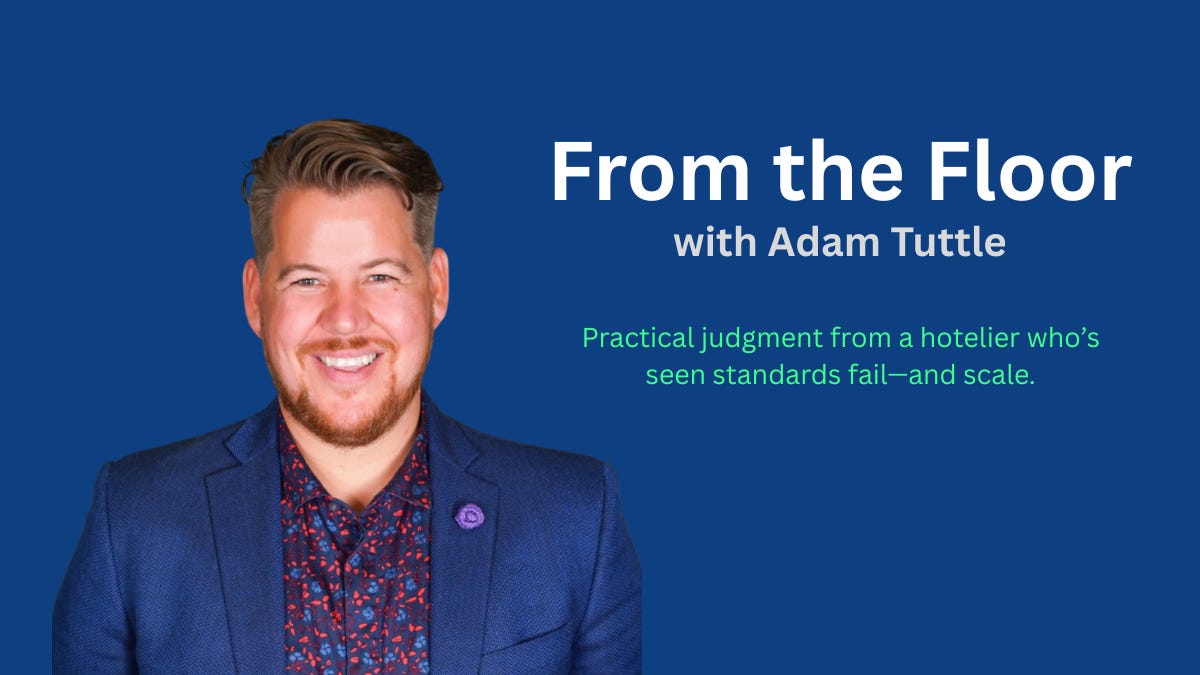
Welcome to the first edition of From the Floor — a space where we get back to the fundamentals of hospitality operations and leadership.
Before Yipy was a company, it was a concept born out of years spent on the ground in hospitality. My journey started like many of yours in the day-to-day hustle of hotel operations. My personal tenure brought me from working for an airport LaQuinta Inn and Suites in Las Vegas to working with Four Seasons Hotels and Resorts across the country, giving me a front-row seat to both ends of the service spectrum. From limited service to luxury, I saw firsthand the challenges and opportunities hoteliers face in delivering consistent, high-quality guest experiences.
After leaving the hotel floor, I launched Economic Luxury, a consulting firm focused on helping properties unlock excellence through operational discipline. I had the privilege of working with brands like Montage, Pendry, Four Seasons, Marriott Luxury Group, tribal nations, Caesars Entertainment, and many independent hotels across the map. I also worked with passionate entrepreneurs running single-property businesses who were committed to raising their service game. Different brands. Different budgets. Different market segments. But one universal truth stood out:
The strength of a property is built on the strength of its standards.
Not branding.
Not technology.
Not even great people — at least not alone.
When standards are missing or inconsistent, even the best teams struggle. Managers spend their days putting out fires. Guests get a different experience depending on who’s working the shift. Brand identity blurs. Turnover rises. Loyalty fades.
On the flip side, properties that clearly define their standards and live them consistently operate differently. They scale better. Train faster. Serve more personally. Deliver more consistently. And they do it without burning out their people or relying on passed-down knowledge that disappears the moment someone walks out the door.
That’s why I began every consulting engagement in the same place: What are your standards? Where are they documented? And how does your team interact with them every day?
So in this first issue of From the Floor, I’m starting where I’ve always started — with the basics - standards.
To bring this to life, I want to share a simple but powerful analogy from an unlikely place: the McDonald’s Big Mac. Because when you zoom out from the gold arches and the sesame seed bun, you’ll see a principle that applies just as much to an airport hotel as it does to a five-star resort.
When someone walks into a McDonald’s and orders a Big Mac, there’s no confusion. They know what they’re going to get: “Two all-beef patties, special sauce, lettuce, cheese, pickles, onions on a sesame seed bun.” Not because they memorized the ingredients, but because the standard is clear, consistent, and repeatable.
That’s the power of operational standards.
They don’t just make life easier for your team — they shape the guest’s expectations. And that’s exactly the point.
Standards aren’t about guessing what a guest wants. Standards help the guest understand what’s being offered — and give them a clear starting point to personalize their experience. No pickles? Easy. But it only works because the default is understood.
In the same way, a property’s standards serve as a foundation. They also ensure:
Teams know how to deliver consistently, not just when leadership is watching.
Guests understand what to expect — and how to adjust it for their preferences.
Service is personalized because of your structure, not in spite of it.
When every team member delivers on a shared definition of quality, operations run smoother, guests are happier, and the brand (or property) earns trust — no matter the segment, size, or rating.
Just like the cook doesn’t stop to decide if you look like someone who wants pickles, your team doesn’t have to guess. They follow the standard. And when a guest asks for a change, the personalization feels natural and not improvised. Because it’s built on a clear foundation. That’s what builds trust. That’s what creates loyalty and efficiency!